
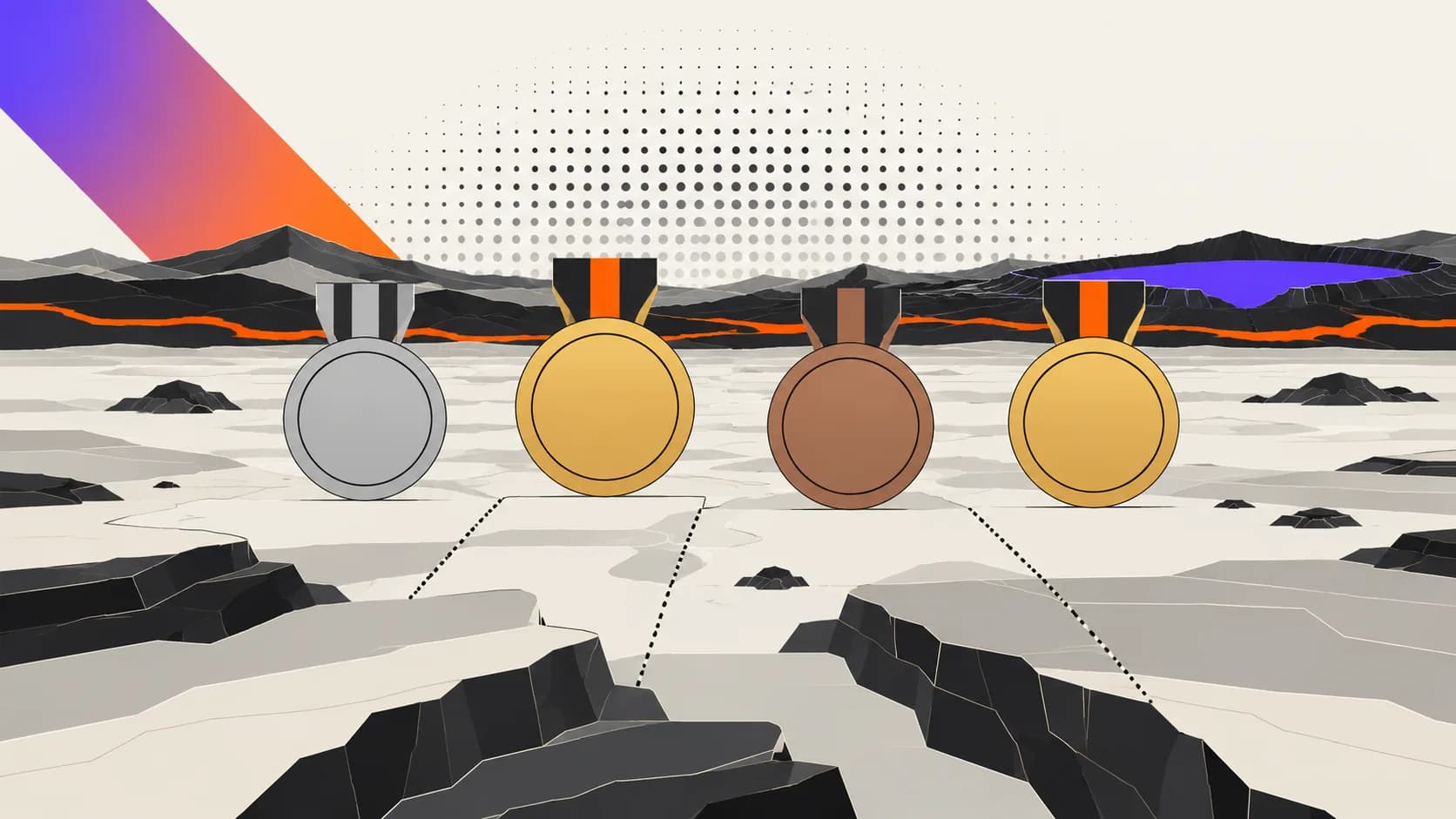
The title sounds like too much. The writer knows it, and still has not found a more honest way to put it. Since high school the writer has been chasing a kind of proof: that work made by one's own hands can stand in front of strangers and stay standing. Report cards never offered that proof. Teachers hand them out, the school stamps them, and that is the end of it. Competitions are different. There the writer stands without the school's name behind them.
Why Compete
Back then the writer had no other way to measure themselves than grades. Good grades meant safe, average grades meant fix yourself, and that was the whole arithmetic. Then the writer entered a first competition and found a measure nobody teaches anywhere: judgment from people who do not know the writer, owe them nothing, and do not care which grade they are in. It was frightening. Precisely because of that, it felt real.
There was something else the writer was after without knowing it: deadlines. On personal projects the writer could stop anytime and nobody would object. In a competition the clock keeps running. Submission is next week; whatever is ready is ready. It felt harsh the first time, then slowly turned into a habit the writer carries to this day, into daily work.
What Draws Me to Competitions
What kept the writer coming back was not the prizes but the open-ended format. The problem is not given; the writer has to write it. Most people think the hardest part is solving a problem. The writer found the opposite: deciding which problem is worth working on, for whom, and where the boundary sits, is far harder, and far more often avoided.
Competitions also push the writer into rooms they know nothing about. Children with dyslexia, dyscalculia, and dysgraphia learn differently, and the writer had to understand that before daring to design anything for them. Disasters and evacuation: the writer started from zero again. The budget is measured in weeks, yet within that time the writer has to become knowledgeable enough to make assumptions that hold up. No class teaches that method. Since getting used to it, the writer has become good at appearing to understand first, and actually understanding shortly after.
And then there are other people who have also worked hard. The writer's own ideas always feel like the most reasonable ones until ten versions from other people appear. Some are simpler. Some are braver. Learning to look at them without feeling threatened is the part that never finishes.
What It Takes
Competition information never arrived on its own. The writer had to hunt for it: on posters, in group chats, in announcements that had often already passed. The questions were always the same: is this relevant to the writer's capacity right now, and is there a real chance of winning? Pragmatic, of course. But that choice flows everywhere. The competition selected determines the idea that ends up on the page, and it also determines which boundaries are not worth chasing.
Once inside, the work gets broken down. Three big stages: before the competition, during it, and after. Each stage breaks down further into small milestones, so that this week the writer knows exactly what must be finished. It sounds ordinary now. When the writer was in high school, this had never even occurred to them.
All of this came from a mentor who was willing to teach. Not a course, not a book. Someone who sat down, mapped the direction, and, most often, held the writer back. Held them back because the writer always wanted to add more. The big picture was already there and the writer was still thinking about adding this and that, already imagining it at scale, when what the matter required was finishing the competition. The mentor showed where to stop, and it turned out that was the hardest part to teach.
In scientific writing the shape of that boundary is clear: the idea is communicated, made doable, with assumptions supported by evidence from experiments. That is all. There is no room for product blueprints or grand scaling plans. The writer did not understand this rule then. What the writer noticed was only the pattern: every time it was followed, the work got finished; every time it was broken, the work stopped halfway.
The first medal arrived in August 2020, when the writer was still in high school. It was called Ilexia: an Android educational game built with Construct 2 for children with dyslexia, dyscalculia, and dysgraphia. The problem was simple and real; learning media for those three conditions was scarce. What the writer offered then was still a design, but it was enough for a silver medal at the national Scientific Writing Competition.
Six months later the writer returned to the same problem. In February 2021 the shape changed into a website: Difedu, a site design for children with dyslexia, dyscalculia, and dysgraphia. Same problem, slightly different angle, farther competition. This time the writer came home with a gold medal, at the international level. Two medals from one problem, half a year apart, and the writer only realized it much later: the same problem can be answered many times in different shapes.
In March 2021 the writer moved to a completely different problem. Together with a team, the writer built Resavi: a floating dome with a water system, designed as a new approach to disaster mitigation and evacuation. At the Indonesia National Science Enterprise Challenge the work ended with a bronze medal. Not everything the writer attempts comes back as gold, and that fact is a lesson of its own.
Four years later the writer repeated the process at university, this time without a mentor. Fostifest 2024, a national competition run by FOSTI UMS, was open-ended: the team defined its own problem. The writer and the team chose attendance for events, then built SienSi: a QR-based attendance system that can be configured for medium to large events. The result was a gold medal in the Software Development category. Only one thing was different: nobody was holding the writer back this time. The writer set those boundaries themselves.
What I Got
The writer felt the realest part of this only during the thesis. Finished in one semester, and it did not feel heavy, because the work was not unfamiliar: pick a reasonable problem, bound its scope, break it into stages, then do it. The writer has carried that way of thinking since high school, from someone who was willing to teach. The thesis only used it again.
As for the four medals, the writer has forgotten what the prizes were worth. What remained are the small invisible habits: first finding out which problem is worth it, refusing additions that are not needed, finishing what was started. The title really does sound like too much. But the writer is still chasing the same thing today, and at least now there is a trail of it.